
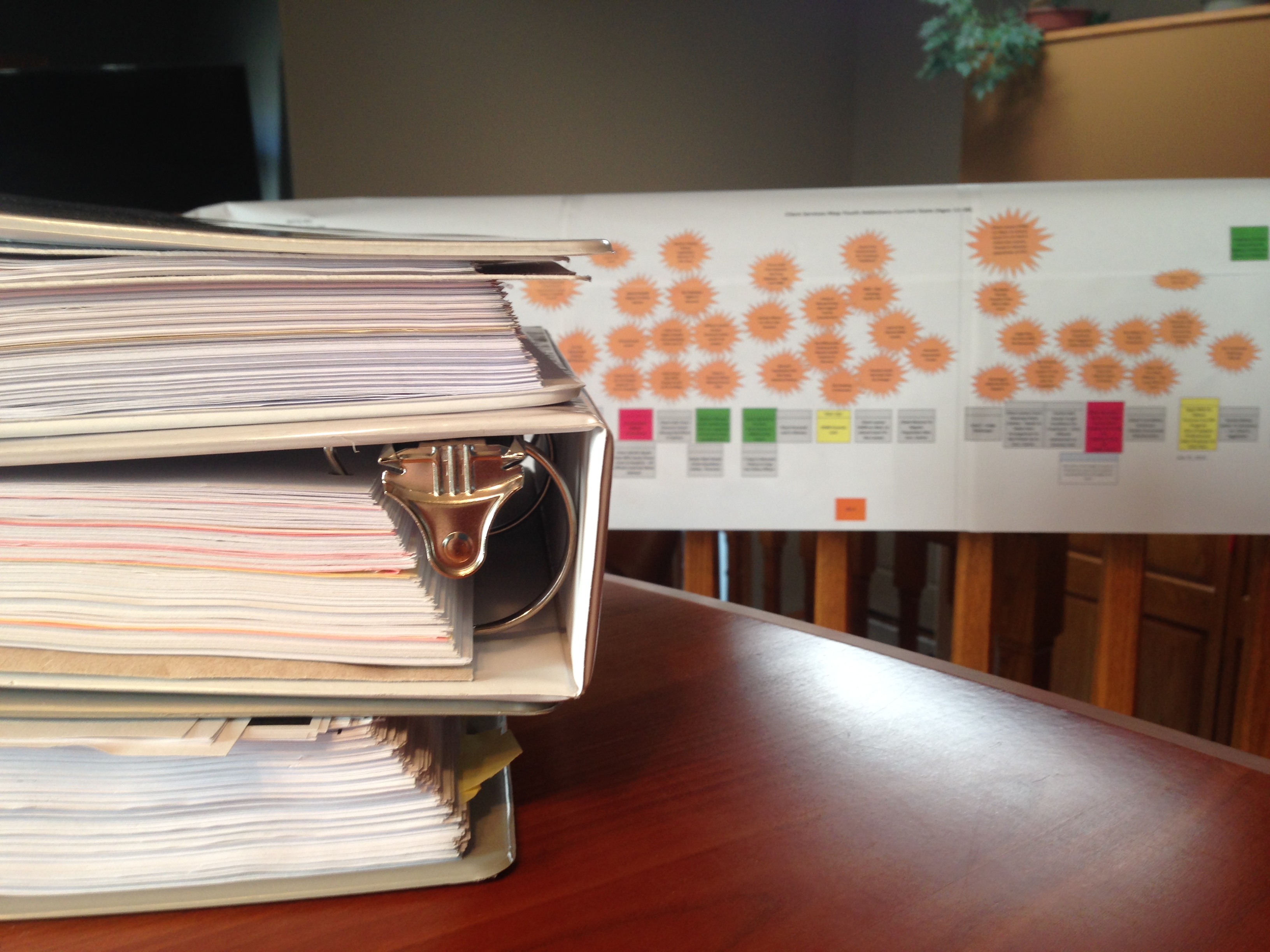
On Tuesday we presented Jordan’s story to a multi sectoral group of stakeholders as part of the Mental Health Commission review.
I hadn’t realized how heavy this task was weighing on me – the relief I felt afterwards was enormous. I learned I could tell his story and not fall apart. And that I could tell it in a way that affected people and move them to want to change things.
In preparation for our presentation, we spent an afternoon in mid-April with staff from the commission; walking through Jordan’s history and creating a client experience map. This required me to spend the Easter long weekend finally making my way through the three binders of health records we had gathered – a task I had been dreading.
It’s not like anything lurking in those stacks of paper was going to be a surprise – we lived it after all. What I think I was most afraid of was possibly discovering comments written about Greg and I; judgments about our handling of the situation. In the end there was only one, written by his psychiatrist as he attempted to handover Jordan’s care to someone else.
“His mother is ‘burning out and disengaging” and his father displays some ‘enmeshment’”
I looked it up. Enmeshment refers to “an extreme form of proximity and intensity in family interactions. In a highly enmeshed, overinvolved family, changes within one family member or in the relationship between two family members reverberate throughout the system”.
Isn’t that the exact description of what you want to see in a close knit family? Love and concern and support and when one member of the clan is hurt, the others bleed too? Yet according to Jordan’s psychiatrist, this was a bad thing. That one of us was under involved and the other was over involved.
That seems to be a common theme in mental health and addictions services. “You have to let them hit bottom”, “You need to kick them out so they suffer the consequences”. Are you kidding? This is my vulnerable child you are talking about. Given the horrible outcome we experienced I would suggest it seems pretty obvious we were not involved enough.
What is becoming clearer to us now is that Jordan suffered from a deep clinical depression. And had been suffering for a very long time. It is likely what drove him at age 13 to try and run himself to death, and control his food intake and exhibit signs of OCD. We saw it, it concerned us, I even called the mental health intake line to get him an appointment with a psychologist, but in the end we didn’t follow through. Fear of labeling him? Worry that placing too much attention on it might take a passing bad moment and exacerbate it into something worse? Denial? All of the above?
Of all the regrets I carry with me, this is the one that gnaws at me the most, the one I feel could have made all the difference. If I had it all to do over again, I would have insisted we put him into therapy in Grade 6. What if he had been able to develop coping mechanisms that would have prevented the descent into deep depression?
Reading the various descriptions of his psychotic episodes didn’t bother me; the bizarre thoughts and behavior. After all, those had simply become part of our new “normal” life. It was the unexpected reminders that my boy still loved us that reduced me to a sobbing mess. Like the nurse’s note from May 2012 where he expressed to staff that he really wanted to go over to the RUH Mall to buy his mom a mother’s day gift and was worried that it would take longer than the 15 minutes his pass allowed. Or when he was arrested last March and told the corrections center staff that he had not slept for 96 hours because his parents were away and he was worried that something would happen to the house or his brother if he fell asleep.
Reviewing all of his various records in one sitting confirmed what we already knew; that the last four years were a complete gong show. Everyone was focused on the drug use and the psychosis. No one was paying any attention to Jordan as he stated again and again that he was depressed. No one questioned whether the car accident was an attempt at self-harm. Only one nurse ever talked to him about all the self-inflicted burns on his body and what the motivation might have been to hurt himself. There was no communication or handover between psychiatry and his family physician, between the forensic unit and his family physician. That first critical year after his first episode of psychosis he had three 15 min appointments with a physician in October, then nothing till he ended up back in hospital the following September. He had little to no contact with the community mental health team and no treatment plan was communicated to his family physician. He was left to the mercy of his altered brain chemistry – and his brain proved to be an unmerciful god.
That was the story we shared on Tuesday.
We began by asking the group’s permission to place Jordan’s portrait above his value stream map. I told them it was important for them to really see our son as we told his story – because not a single person he came into contact with during his journey – not the police, not corrections, not justice and certainly no one in health care – every saw him as anything but his disease. No one ever saw the person he was and the person he could have been.
We were the last to speak and I think it was almost 4:15 when we began. At 5:00 I noticed the time and apologized to the group, said we would wrap it up. One person responded that he couldn’t speak for the group, but even though he was facing a drive back to Prince Albert, he was riveted by our story and could we please continue. So we did.
Greg spent the evening afterwards replaying it in his mind and wasn’t really happy with how it went – I think he wanted to impart far more facts to the group. I saw it as an opportunity to tell a compelling story – and based on the comments people made on their way out, they will never look at their work the same way. One woman thanked us and said “your story has left me with a heavy burden. I need to do a lot of self-reflection”.
I finished with a challenge to the group. I told them I believed with all my heart that Jordan’s death was absolutely preventable. That our fractured, underfunded, under resourced and quite frankly, fucked up mental health care system directly contributed to his death.
I re minded those who work in health care about the story of Mary McClinton, the patient whose death lead Virginia Mason hospital on a mission to improve patient safety. I said today we are offering you the story of our beautiful, talented, brilliant boy in the hopes that you will be equally inspired to radically change the care and service experience for those whose mental health issues are every bit as critical as those with physical illness.
We spent the next day working with the group to identify barriers and challenges and making recommendations for how the various sectors (education, social services, police service, justice, corrections and health care) could work more effectively together. This was where Greg was able to share his carefully compiled data and research to great effect. We are cautiously optimistic that telling our story will have made an impact on the Commission’s report; that in the end it will have been worth the emotional cost that comes with telling it. But regardless, actually getting through those two days was more evidence that the ground is feeling firmer under our feet every day.
 Lori's Blog